
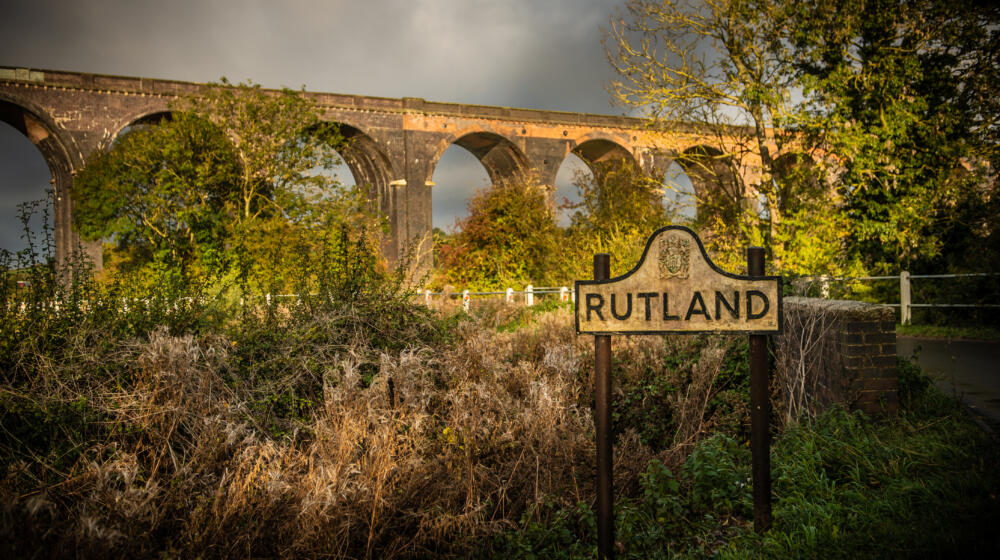
There is a familiar joke about Rutland: that it feels like England 50 years ago.
A recent article in The Guardian saw, Lucy Knight explore that idea while looking at the uncertainty facing England’s smallest historic county. It is a description that might make some Rutlanders smile, but it also captures something important. Rutland is different. Its scale, character, traditions, communities and independent spirit are part of what makes it special.
And that difference matters.
At a time when local government was being reorganised and Rutland’s structure was in limbo, there was an important question that reached beyond council boundaries and administrative arrangements: will Rutland continue to be recognised as Rutland?
For local residents, businesses and visitors, the answer matters enormously.
Rutland is more than an administrative boundary
Rutland is not simply a line drawn around a local authority.
It is a historic county with a distinct identity that has survived centuries of change. From Oakham Castle and the county’s historic market towns to its villages, countryside and the landscape around Rutland Water, the name Rutland carries meaning.
That identity was formally restored in 1997, when Rutland regained its status as a ceremonial county, alongside its separate Lieutenancy and Shrievalty. The strength of local feeling was an important part of the case for restoring Rutland’s distinct status. In evidence to Parliament at the time, Rutland’s particularly strong sense of community identity was explicitly recognised.
Almost three decades later, that sense of belonging has not disappeared. If anything, it has become one of Rutland’s greatest assets..
Ceremonial status may sound symbolic – but symbols matter
It is fair to ask what “ceremonial status” actually means in practical terms.
It does not mean that every service has to be delivered by a separate council. It does not mean Rutland cannot work constructively with neighbouring areas. And it certainly does not mean that improving public services should not be a priority.
But there is a danger in dismissing ceremonial status as merely symbolic. Symbols are how communities express continuity.
A county name. A Lord-Lieutenancy. A High Sheriff. County traditions. Historic institutions. The ability to say, with confidence, “this is Rutland.”
These things help connect today’s Rutland with the Rutland that existed generations ago – and with the Rutland we want future generations to inherit.
The government’s July 2026 plans meant Rutland would have become part of a much larger unitary structure. This did not necessarily mean the county must lose its historic name, identity and civic functions, and MP Alicia Kearns has called for those to be protected. Governments plans have since been put on hold, leaving the future currently unknown.
Small does not mean insignificant
Perhaps this is where the comparison with Lucy Knight’s Guardian article is most useful.
There can be an affectionate temptation to regard Rutland as a quaint throwback – a tiny county where things feel a little slower, more traditional and more connected. But that should not be mistaken for being irrelevant.
Rutland’s small size is precisely what gives it some of its strengths.
People know their communities. Independent businesses have a strong presence. Visitors can explore a remarkable amount within a relatively small area. Local organisations can collaborate. Residents have a powerful sense of ownership over the place they call home.
That is something worth celebrating, not something to be absorbed and forgotten.
Protecting Rutland is about looking forward, not backwards
Keeping Rutland’s ceremonial status is sometimes portrayed as an argument for preserving the past.
We see it differently.
It is about making sure the future has somewhere distinctive to celebrate.
Rutland can embrace change while retaining its identity. It can work with larger neighbouring authorities while remaining visibly, proudly and unmistakably Rutland. It can support modern public services while protecting the heritage, culture and sense of place that make the county attractive to residents, businesses and visitors alike.
Indeed, perhaps the strongest argument for retaining Rutland’s identity is that it is already working.
Businesses use it.
Visitors recognise it.
Residents feel passionately about it.
And communities have spent generations building it.
The proposed reorganisation of local government may change how services are administered. But it does not have to erase the things that make Rutland Rutland.
Let’s keep saying it: Rutland
There is power in a name.
Rutland tells a visitor where they are.
It tells a business what community it belongs to.
It tells a producer where their food comes from.
It tells a resident something about home.
And it tells the rest of England that the smallest county can have a very big sense of identity.
So yes, perhaps Rutland sometimes does feel like England 50 years ago.
But perhaps that is part of the point.
In a world where places can increasingly feel interchangeable, Rutland still feels like somewhere.
Let’s make sure it stays that way.
Useful Questions & Answers:
Q: What is the population of Rutland?
A: Just over 41,000
Q: Why is Rutland’s ceremonial status in question?
A; When the Lieutenancies Act 1997 was drafted, Rutland was still legally part of Leicestershire, so it was not named as a standalone ceremonial county. Although Rutland won its administrative independence later that same year, Parliament never updated the Act to protect its ceremonial status in its own right. As a result, Rutland’s ceremonial identity relied entirely on the existence of its current council, leaving it legally vulnerable to being re-absorbed by Leicestershire if that council is abolished. Whilst the government have given assurances that they do not wish to remove the ceremonial status, and newly announced council structure with the 7 new wards see’s Rutland’s boundaries protected meaning LGR proposals do not alter, cross of divide Rutland’s existing administrative boundary, MP Alicia Kearns is still fighting for a legal guaranteed of the ceremonial county status before any reorganisation takes effect.
Q: Will Rutland still be a county if it does not have ceremonial status?
A: Historic Counties Institute recognises Rutland as one of the 39 historic counties in England, this is not affected by Local Government Reorganisation. However, in England, this classification serves a completely different purposes to a ceremonial county status, which carries actual legal, civic, and structural weight.
Q: Is the Isle of Wight smaller than Rutland when the tide is in?
A: The Historic Counties Institute recognises Rutland as the smallest county in England as 147 sq miles (382sq km), as the Isle of Wight is traditionally considered part of the historic county of Hampshire. In the list of ceremonial counties, Rutland is fourth smallest after the City of London, Bristol and the Isle of Wight which is listed as 146.7 sq miles (380 sq km).
Q: What does the Lord Lieutenant of Rutland do?
A: The Lord-Lieutenant of Rutland acts as the King’s personal representative in the county. Dr. Sarah Furness currently holds this non-political, ceremonial position. Main duties include managing royal visits, arranging awards and honours, supporting community organisations and the Armed Forces.
Q: What does the High Sheriff or Rutland do?
A: The High Sheriff of Rutland represents the monarch in the county and supports law, order, and community services during a one-year ceremonial term. They support the police, judges, emergency services, and the Rutland Counts, they help and highlight voluntary groups, charities, and social cohesion projects in the county and they attend official royal visits, civic functions, and public gatherings as the King’s chief judicial representative.
Q: What is the difference between Lord Lieutenant and High Sheriff?
A: The Lord-Lieutenant is the permanent personal representative of the monarch in a county, while the High Sheriff is an independent, one-year appointment focused specifically on the judiciary and law and order.
