
Rutland may be England’s smallest historic county, but it offers visitors something truly special: a landscape where history, legend and natural beauty come together. If you’re looking for a destination rich in stories as well as scenery, Rutland is waiting to be explored…
The Lost Royal Forest of Leighfield
In the medieval period, Leighfield Forest stretched across Rutland and Leicestershire as a vast royal woodland, where parts of the land were reserved for the hunt and governed by strict forest laws. Established soon after the Norman Conquest, it once dominated much of southern Rutland, its quiet glades and hidden paths echoing with the footsteps of royalty and their game. Today, most of the forest has vanished, but traces of its former life remain, including Prior’s Coppice, historic place names, and hunting lodges such as Leighfield Lodge and Catmose Lodge (now Catmose House). Yet beneath the modern landscape, the mystery of this ancient forest still lingers, inviting walkers to imagine a time when deer ran freely and trees dominated the landscape.

Battles and Battlements at Fort Henry
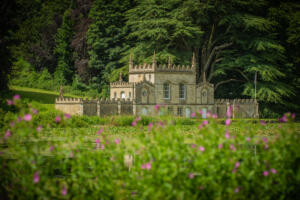
Set beside a tranquil, man-made lake at Exton Park, Fort Henry is a striking Gothic folly commissioned by the 6th Earl of Gainsborough. Designed in the late eighteenth century as a private “pleasure house,” it formed the theatrical centrepiece of an ornamental waterscape created for leisure, spectacle and entertainment. Originally known as the Pond House, the building played host to lavish gatherings, where the Earl and his guests enjoyed elaborate boating parties and staged mock naval battles upon the lake.
Though never intended for defence, Fort Henry captured the romantic spirit of the age, reflected in the lake and half-hidden by trees, it remains one of Exton Park’s most evocative features offering a glimpse into a time when aristocratic pleasure and imagination shaped the countryside as much as function and necessity.
Rutland Water’s Sunken Village
Rutland Water is one of the region’s biggest attractions, offering cycling, walking, birdwatching and watersports. Yet beneath its calm surface lie the remains of villages deliberately flooded during its creation in the 20th century. On misty mornings, some visitors speak of hearing distant church bells – an echo of long-forgotten villages swallowed by water. When water levels drop, traces of roads, walls, and foundations occasionally reappear, turning the lake into a place where beauty and history meet.
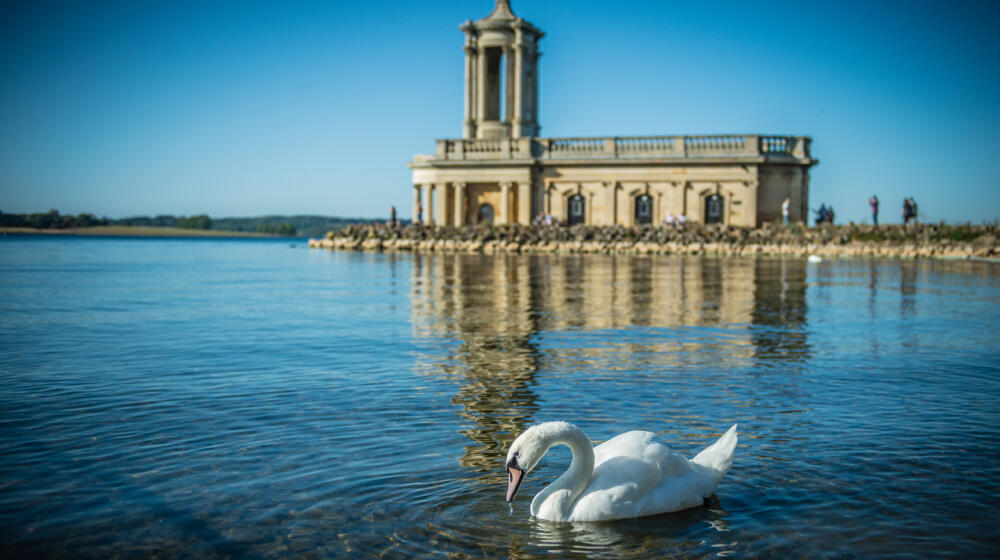
Of course, one building destined for demolition was saved by a local campaign and is now the landmark that makes Rutland Water so iconic. Normanton Church, once St. Matthews, had to have its floor raised and a surround of protective boulders which gives a ‘floating’ appearance.
The Silent Guardian of Braunston Church
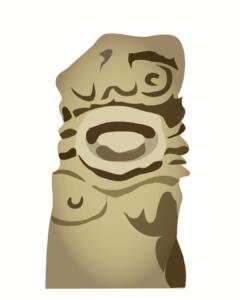
In the churchyard of All Saints, Braunston, a curious carved stone known locally as the Braunston “Goddess” stirs fascination and unanswered questions. Hidden for years as a worn doorstep until its rediscovery in the 1920s, this enigmatic figure stands at the base of the west tower, its origin and meaning still debated. Some have called it a Sheela na Gig (a type of medieval grotesque found on churches across the British Isles) though the Braunston carving lacks some of common markings typically found.
Whatever its true meaning, Braunston’s curious stone- weathered, half hidden and unlike typical examples invites visitors to question its presence. Was it a guardian figure placed to ward off harm? A relic of pagan beliefs or simply a forgotten fragment of medieval art whose secrets have been lost to time?
Martinsthorpe: Rutland’s Deserted Village
Among Rutland’s quiet lanes lies Martinsthorpe, a village where time seems to have stopped. First recorded in 1205, it was once a thriving medieval settlement, but by 1952 it was completely abandoned, leaving it as one of only eight parishes in England with no population. More recently, Martinsthorpe House, once the stable block for the now demolished Martinsthorpe Hall and previously known as Old Hall Farm, is now lived in and stands totally alone surrounded by the remnants of the village which sits along an ancient ridgeway, possibly dating back to the Bronze Age; its well-preserved earthworks offer a rare glimpse into medieval life. Silent yet full of history, Martinsthorpe is a hauntingly beautiful stop for anyone curious about England’s forgotten corners. Why was it deserted? The answer is lost to time, leaving only traces of the past and the quiet presence of those who once lived here.
Ashwell Wishing Well
A few miles from the empty fields of Martinsthorpe, a spring still rises at the edge of Ashwell. Known today as the Wishing Well, it was once called a holy well and may even have given the village its name – the well among the ash trees.
Long before coins were dropped into wells for luck, springs like this were treated as sacred. In ancient Britain, water emerging from the ground was believed to carry unseen power, and offerings were left in thanks or quiet hope. The stone well-house dates from the 19th century, above the opening, a message is carved in stone:
All ye who hither come to drink,
Rest not your thoughts below,
Look at that sacred sign and think
Whence living waters flow.
Whether it was meant to comfort or caution is unclear. Like other curious spots in Rutland, the well endures altered, renamed but quietly present – leaving more questions than answers.
To uncover more of Rutland’s intriguing and sometimes puzzling past, visit our Heritage Walks page and let it inspire your next adventure into curiosity.
